
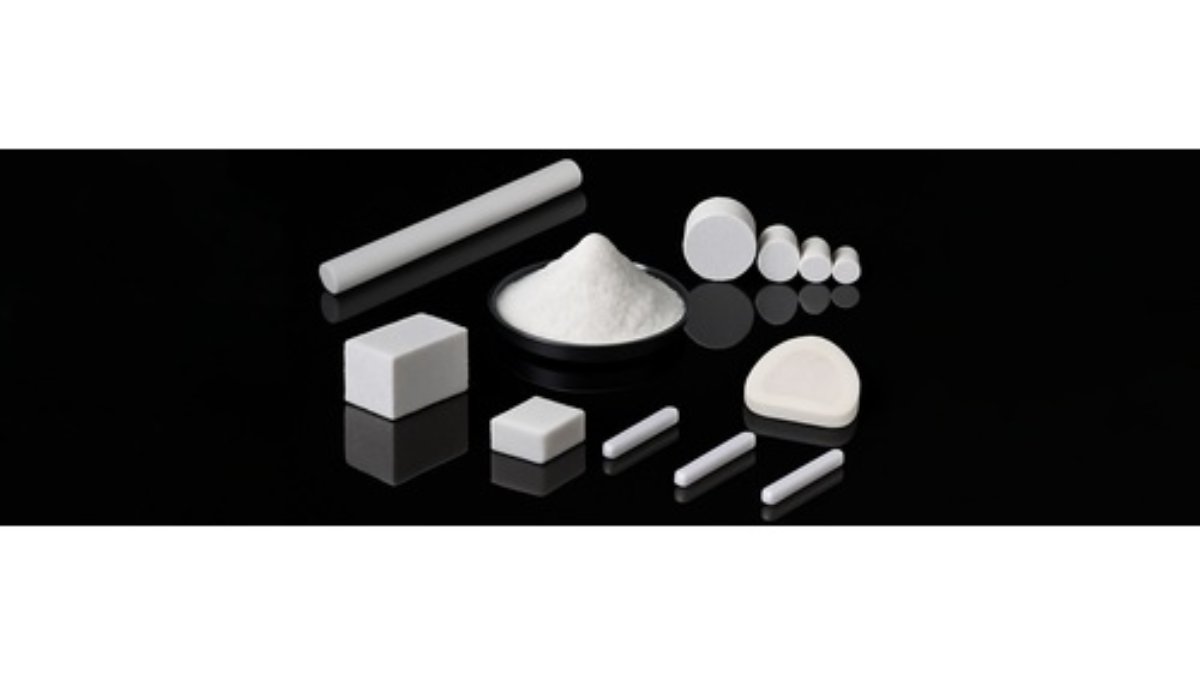
A tooth-colored crown and a porous bone substitute may both be ceramic, but their jobs are quite different. The crown needs to retain its shape and withstand repeated contact. A bone substitute may instead provide a temporary mineral framework whose interaction with surrounding tissue is part of its purpose. Calling both biocompatible ceramics does not make them interchangeable.
That distinction is useful for anyone buying medical materials. Hydroxyapatite powder and dental zirconia enter different manufacturing routes and require different acceptance criteria. The intended component, its exposure, and the way it will be processed should be established before purity figures are compared.
Dense ceramics carry loads and preserve geometry
Zirconia is familiar in dental restorations because it offers useful mechanical properties alongside a tooth-colored appearance. It is a family of materials, however, rather than one fixed composition. Stabilizer content, phase distribution, and processing affect its response.
Increasing translucency can involve changes that also alter resistance to fracture. Experimental comparisons of dental zirconia compositions have measured this relationship between microstructure, optical behavior, and mechanical properties. A highly translucent material should therefore be evaluated against the component’s demands, rather than assumed to be an improvement in every respect. [1]
Dense structural ceramics are also used in orthopedic devices, where surface condition, wear, and mechanical reliability matter. The requirements for a joint bearing differ from those for a dental crown. A general ceramic designation cannot replace the specifications governing a particular component.
The common purchasing question is what the finished geometry has to survive. Repeated loading, thin sections, contact surfaces, and interfaces with other parts all influence the material and manufacturing choices.
Calcium phosphates interact with a different environment
Hydroxyapatite is chemically related to the mineral component of bone and teeth. It can be used in bone-substitute materials, coatings, and composite development. Its function is different from that of a dense zirconia restoration.
Other calcium phosphates, including beta-tricalcium phosphate, have different dissolution and biological behavior. Research comparing bone-substitute compositions has also found differences in the way the tested materials were resorbed and replaced. Those observations apply to the tested forms and experimental conditions; composition alone does not describe the entire response. [2]
Porosity, accessible surface, crystallinity, and local conditions influence what happens at a material interface. A powder does not behave exactly like a dense block made from it. A coating adds another geometry, with a small thickness and a supporting substrate.
For this reason, a request for a bone-related ceramic needs to identify whether the material will become a porous structure, a coating, or part of a composite. That information guides a useful discussion about powder properties.
A material form is part of the specification
Medical ceramics may be purchased as powders, granules, blanks, discs, or machined parts. Each form places a different amount of work with the supplier and the buyer.
Dental zirconia discs are a practical example. A pre-sintered blank intended for milling has already undergone processing that a raw powder has not. Its dimensions and subsequent firing behavior belong in a different purchasing specification.
A powder-based project needs information about particle distribution, agglomeration, additives, and the proposed forming route. High chemical purity does not establish that the material will flow, compact, or disperse as required.
The receiving team should know which measurements describe the delivered item and which are typical material data. A chemical certificate, a dimensional report, and a phase analysis answer different questions. Collecting the right information is more useful than accumulating documents without a defined acceptance requirement.
Processing determines the surface that is used
Pressing and sintering change a powder into a component with its own density, grain structure, and defects. Grinding, polishing, coating, and cleaning can then change its surface again.
These steps help explain why a raw material cannot be judged solely by the reputation of its chemical family. A suitable composition can still produce a poor component if the process leaves defects or an inappropriate surface. Conversely, a well-controlled process needs feedstock whose properties remain sufficiently consistent.
Biological evaluation follows the actual device and exposure. FDA guidance considers the final finished form, including relevant manufacturing and sterilization effects. It does not treat an individual material purchase as approval of every device that might be made from it. [3]
For a development project, this means keeping material information connected to the manufacturing record. If a prototype succeeds, its powder, process, and finishing conditions should be identifiable when the component is ordered again.
An application name can also conceal a difference in function within the same device. A ceramic may be a load-bearing body, a coating, a porous region, or an insulating component. Each position creates its own exposure and manufacturing requirements.
A development drawing should identify that position explicitly. If two materials are being considered, compare the complete component requirements rather than assuming that the same geometry and finish suit both. A change from a persistent structural ceramic to an interacting calcium-phosphate surface can change the design question substantially.
This is useful during early discussions with colleagues as well as suppliers. The team can agree on what the component needs to do before selecting the data-sheet fields that will determine whether a candidate material is worth testing. It also helps prevent a general claim about biocompatibility from substituting for the particular optical, mechanical, or surface requirement the instrument actually needs.
Discuss requirements in terms a supplier can act on
Stanford Advanced Materials (SAM) offers biocompatible ceramic material options for research and manufacturing development. An inquiry is more useful when it identifies the intended material form and the job it has to perform.
For powder, include composition, stabilizer or phase requirements, particle data, quantity, and the planned forming method. For blanks or components, add dimensions, tolerances, surface requirements, and any downstream processing. State which documents or measurements are needed before the order is placed.
Some projects begin with an open material comparison. In that case, distinguish requirements that are fixed from those that can change. The need for a particular optical behavior may be fixed while a blank diameter remains adjustable. The need for a calcium-phosphate phase may be more important than a preferred package size.
This helps keep sourcing practical. A quotation can describe an identifiable material and delivered condition, while prototype testing evaluates the component made from it. The link between those two stages is what turns a broad interest in medical ceramics into a workable material purchase.
References
[1] Composition, processing, and properties of biphasic zirconia bioceramics: relationship to competing strength and optical properties
[2] Physical and Histological Comparison of Hydroxyapatite, Carbonate Apatite, and β-Tricalcium Phosphate Bone Substitutes
[3] Basics of Biocompatibility: Information Needed for Assessment by the FDA
